
Anubandha Chatuṣṭaya - The Four Essential Components of a Treatise

In classical Saṃskṛta traditions, all serious, spiritual or philosophical works begin with the Anubandha Chatuṣṭaya - A fourfold foundation that answers four essential questions:
Viṣaya - What is the subject?
Adhikāri - Who is eligible to read this?
Prayojana - What is the purpose?
Sambandha - How are all these connected?
This fourfold structure ensures that both, author and reader engage with the work from a place of clarity and intention. By bridging this timeless method with a contemporary voice, my hope is to invite more seekers into the depth and authenticity of the path, without losing the subtlety or reverence it deserves.
In honoring that tradition, I present this section, staying true to its spirit while making it accessible to a wider audience.
Viṣaya (What is the subject?)
This book is a doorway into the world of “Aghora”, not as a fringe philosophy or an esoteric curiosity, but as a living path, a way of being, and a path to return to the Source. One that integrates insights of the Vedas and transformative practices of Tantra into a unified current of awakening.
At its core, this book offers a blueprint of the path.
Whether you're new to Aghora or already are drawn to its pulse, this work seeks to clarify the terrain, removing layers of myth and mis-understanding.
This is not a book for casual reading; it is a treatise for disciplined study.
The language of this book may at times feel demanding, as it serves a precise purpose - clarity of meaning. The structure used is deliberate, as every word has been chosen with great care, and even the smallest change to simplify or make it easy to study, could distort the intended meaning.
If the form challenges you, allow it; use a dictionary, make notes, revisit passages. Such rigor in efforts will ensure that the knowledge you absorb remains faithful to its original intent, free from dilution or misinterpretation.
The book unfolds in three parts:
Roots of Aghora
This section addresses the often-misunderstood nature of Aghora in contemporary times. It seeks to reclaim the tradition from sensationalism, grounding it in authentic scripture and revealing it as a profound and dignified path of spiritual realization.
Seed and Source
At the heart of this work lies a core treatise authored by an anonymous Illumined One. The anonymity is not for secrecy, but to shift focus from personality to principle; from the messenger to the message. This part lays the philosophical foundation and introduces the essential preliminaries of the path.
The Path
This section offers a high-level view of the central and advanced Sādhanās within Aghora. It reveals the structure of the path in its entirety for the sake of understanding, these are not instructions or a manual. The practices themselves are not detailed here; rather, this is a contemplative outline of what the path is, not how it is undertaken, thus pointing the seeker towards the depth and discipline required for true transformation.
In a time when the spiritual landscape appears marshy and wisdom is often entangled with identities, lineages and ideas of succession, the intention here is to preserve the purity of teachings, free from associations and projections.
The Illumined One and the presenter invite seekers to look beyond outer layers, and rest their understanding in the depths of the message itself. Let this be your compass.
This text is not a manual of instructions, nor does it offer deity-specific rituals or procedural methods. Instead, it is a quiet unfolding of insight, meant to be read with stillness. It sheds light on the inner architecture of Aghora, revealing how its core principles and Sādhanas point directly to the Source.
Adhikāri (Who is eligible to read this book?)
This book is for sincere seekers, those who feel an inner call to understand Aghora in its true light. It is also for anyone who has ever suffered and asked, “Why me?”. It is also for those who, in the midst of pain or confusion, turn towards spirituality seeking solace, understanding, or even liberation.
Often, such seekers encounter teachings rooted in negation, where the world is described as an illusion. In these paths, joy and sorrow are said to arise from false identification with this illusion, and the aim is to transcend or renounce the world to find the real self beyond it.
But Aghora offers another way. It does not ask you to first label your experiences as illusion and then work your way towards the truth. Instead, it begins by affirming:
Everything you are experiencing is real, not in the sense of being absolute reality or permanent, but because it is arising from your own karmic field. Your experiences are a limited reality, shaped by past actions and current conditions. Its limited nature does not make it unreal; it only means, it is part of a larger unfolding.
What you face in this life is not random, nor is it false; it is the result of actions from many lifetimes. You are responsible for your actions, but the outcomes are shaped by a vast and intricate web of karmic forces, far beyond what the mind can compute.
This is why we never fully understand the “Why me?” part.
Aghora does not lead you away from life, but through it. It invites you to engage with every experience, pain and pleasure, loss and gain, the worldly and the spiritual as equally valid, equally sacred, and deeply transformative. The path is not about denial or rejection, but about complete and conscious participation.
To illustrate:
Most traditions might say, “Don’t eat the sweet. It’s impermanent. Eating it will create craving, and when it’s gone, you’ll suffer. Better to renounce it altogether.”
But Aghorīs see things differently. They do not deny the impermanence of the sweet, on the contrary, they see its transient nature clearly. Yet they also see that its appearance in life is not without significance. Whether it arrives through desire or circumstance, its presence carries meaning, it is part of life, it must be met consciously, and dealt with appropriately. An Aghorī tastes the sweet without clinging to its pleasure, and allows it to pass without regret. His/her gaze remains steady, not on the object itself, but on the truth that is seen through its impermanence.
Aghorīs do not approach anything with a sense of indulgence, or resistance. They partake in experiences with full awareness, to confront the karmic residue it represents.
The decision to engage or withdraw also emerges from a deep wisdom, an inner discernment of what is conducive to spiritual progress and what might entangle the being further. Even if the Aghorī chooses to refrain from partaking the sweet, it is not out of denial or rejection, or with the idea to escape karmas, but from a higher clarity to work on it inwardly.
Withdrawal, on this path is a conscious form of engagement. Even when an external action is withheld, the karmic thread is not ignored, it is worked through inwardly, through awareness.
In Aghora, karma can be dissolved not only by performing an act, but also by fully facing its impulse, understanding its roots, and transmuting it at the level of consciousness.
In doing so, layers of conditioning are burnt. Imagine holding burning coal in your hands – this is how karmas are. One way to deal with it is to throw it, an impulsive action that may hurt others or create further consequences. Another way is to suppress the urge, pretending the heat isn’t there, while it continues to burn you silently from within.
But the Aghoric way is different. Aghorīs do not act on the impulse blindly, nor do they deny its presence. Instead, they bring full awareness to it. Observing the heat, the pain, the urge to react. Sitting with it - not to suffer it, but to understand it, feel it fully, and allow its energy to be transmuted.
In this deep, conscious witnessing, the karmic fire burns itself out. The coal cools, not because it was thrown or ignored, but because it was truly seen.
An Aghorī tries his/her best that, the karma of the moment, rooted perhaps in lifetimes of reaction is not perpetuated.
This is the essence of an Aghorī’s attitude towards life: nothing is rejected, nothing is clung to. Every experience, sweet or bitter, sacred or mundane is a valid doorway into deeper clarity.
Life is not a distraction from the path of transformation, but the path itself. The world is not something to escape, but a field through which realization unfolds.
This way of seeing, transforms the very nature of desire, attachment, and action. It initiates a deep inner process, where one begins to understand life not as a collection of random events, but as a coherent expression of karmic intelligence.
Gradually, the seeker learns to discern the layers of the self, recognizes the interplay between inner and outer experiences, and refines the way of life.
Life becomes a field of conscious engagement, where each experience is honored, integrated, and aligned with deeper truth. From this ground, realization of a complete awakening dawns within, leading to a way of being luminous, liberated, and whole.
Even those rooted in other traditions may find resonance here. The teachings of Aghora can shed light on long-held inner questions, offer fresh insight, and expand one's understanding of their own spiritual path.
Importantly, this book does not ask you to abandon your path and adopt Aghora instead. That would, in fact, go against the spirit of Aghora itself.
Aghora emphasizes walking one's chosen path with integrity, depth, and sincerity - to follow it to its end.
But it also recognizes that clarity evolves. One can refine their journey, deepen their perspective, and course-correct without disloyalty to their tradition.
If the lens of Aghora helps illuminate certain blind spots or opens new dimensions within your own path, then let it serve as a guiding light and not a replacement to your path.
In this way, Aghora does not compete with other approaches, it complements them. It invites the seeker to stand fully in life, in whatever form their path takes, and walk it with uncompromising truth.
But a word of caution:
This book is not for the casually curious, thrill-seekers, or those looking for another spiritual novelty. It’s for those who approach sacred knowledge with reverence and a genuine longing to know.
It asks for a level of maturity, as it is meant to be approached not merely with intellect, but with an open heart.
Though the teachings are universal and inclusive, certain details, especially those outlined in the second part, require a seeker to approach a qualified Guru before undertaking any sādhanā. These practices are not to be self-interpreted or casually attempted.
Yet, the illumined being who authored this section, has, out of deep compassion for the sincere reader, chosen to reveal aspects of these higher Sādhanas; not to encourage solitary experimentation, but to ensure that the blueprint of the path is visible in its entirety. Without this clarity, seekers might remain caught in partial understandings or confused by what lies ahead.
It is also important to understand that there are advanced-level practices mentioned in this book which are not for imitation or comparison, they only offer a vision of what is possible.
One should not measure or diminish one’s own current practices against these revelations. Every stage on any path has its value, and what matters most is alignment and sincerity at the stage where one currently stands.
Aghora is not a path to be taken lightly or interpreted individually; its Sādhanas are powerful and sacred, and they require anchoring in tradition through initiation and grace.
The book points to certain preliminary steps - aspects a seeker can begin to cultivate within themselves in preparation for deeper engagement. These insights help the reader honestly reflect on where they currently stand in relation to the path.
For those seeking a Guru, it is essential to remember: there are preparatory stages of inner evolution that one must walk on their own. When you have done all that you can do with integrity and patience, the Guru appears - not to teach what you've already learnt, but to do what you cannot do alone.
Rushing through this sacred process, approaching multiple teachers for initiations, or falling into the modern trap of spiritual materialism is not the way of the ancients.
In the traditional path, you quietly do your part, and when the time is right, the Guru manifests by grace, completing the bridge between effort and realization.
Prayojana (What is the purpose of this book?)
This work holds two purposes, both equally vital. First, it seeks to dispel the clouds of misunderstanding that often surround Aghora. By grounding its philosophy in authentic roots, it invites the reader into a more respectful and expansive understanding of this profound tradition.
Second, it offers a philosophical blueprint, not as a rigid manual, but as a compass. It’s here to offer clarity, help sincere seekers orient themselves towards the Source, and to invite a more neutral and open-minded attitude towards spiritual inquiry.
Ultimately, this book hopes to serve as a quiet companion on your path, not by telling you what to do, but by helping you remember what is true.
Sambandha (How are all these connected?)
The relationship between the path and its purpose:
The connection between the subject of this book “the philosophy and the path of Aghora” and its purpose “clarity, understanding, and eventual return to the Source” is direct and deeply intertwined.
By sincerely engaging with the subject matter presented here, the reader is simply not gathering information about a tradition. Instead, they are entering into a stream of knowledge that has the power to reorient one’s entire understanding of spiritual life.
Aghora, when understood in its true light, dismantles illusions, not just about itself, but also about duality, separation, and the self. It clears the clutter of cultural distortion and mystical sensationalism.
For the qualified seeker - this philosophy becomes more than knowledge. It becomes a mirror, a guide, and a transmission.
It enables the aspirant to develop a broader, more inclusive, and neutral view of the spiritual landscape, which in turn leads them toward a subtler and more direct perception of the truth.
Thus, the relationship is simple yet profound:
Studying Aghora in its authentic form prepares the seeker’s heart and mind to receive the truth the philosophy points to. And when that truth begins to unfold, the seeker naturally begins to move beyond doctrines, towards the Source.
This, is the sambandha:
“The living bridge between understanding and realization.”
This book, then, is not just a container of ideas. It is a living bridge between seeker and Source. The very act of contemplating its contents when done with sincerity, activates a movement within. It clarifies the terrain, aligns the heart, and begins the inner return.
In this way, the subject (Viṣaya) fulfils its purpose (Prayojana) through the right reader (Adhikāri), and the relationship (Sambandha) between them becomes not theoretical, but transformational.
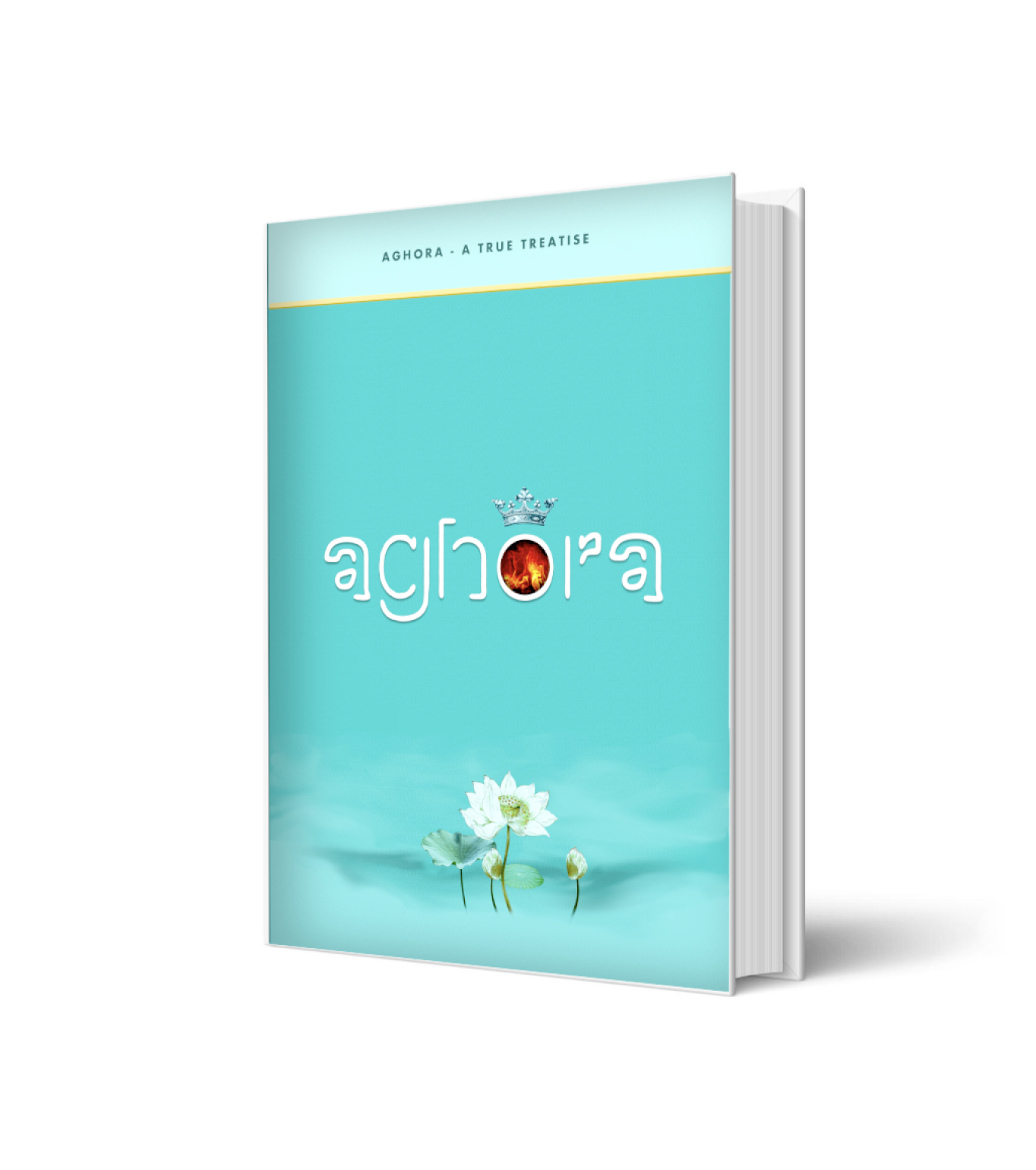
Aghora - A true treatise
This book is a gateway into the fire; a path rooted in the timeless wisdom of the Vedas and transformative power of Tantra. This work offers clarity where distortion has
long reigned. It does not entertain the superficial; it reclaims the sacred.


